
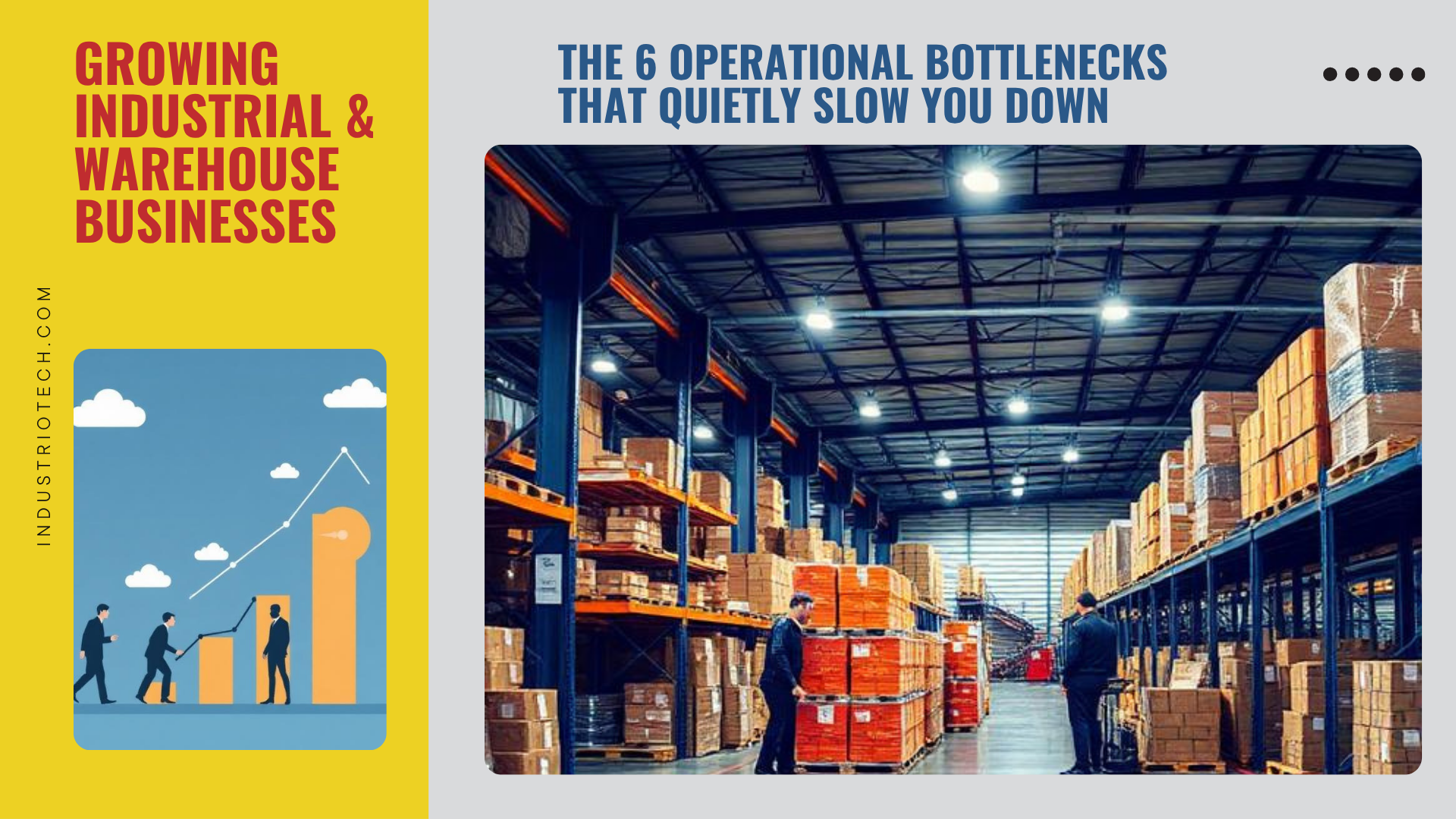
Growing Industrial & Warehouse Businesses
Most operational problems do not appear suddenly. They creep in as businesses grow. What
worked perfectly when the company was small begins to create friction as order volume
increases, teams expand, and systems like ERP become central to operations.
Across many industrial and warehouse businesses, the same operational bottlenecks appear
again and again. The difference is not the problem itself, but the stage of growth at which it
appears.
Stage 1: Early Growth (Below $1M Revenue)
At this stage, teams are small and communication is fast. But operational discipline often hasn’t
formed yet.
- Informal Order Flow
Orders arrive through email, phone calls, spreadsheets, or informal messages. Each order may
follow a slightly different path through the business. As volume grows, inconsistencies create
delays and mistakes.
Solution: Establish a standard order intake process. Every order should enter the system the
same way, ideally directly into the ERP workflow.
- Create one official order entry path (for example: sales → order form → ERP entry).
- Define mandatory order information (customer, SKU, quantity, delivery date) before an
order can proceed. - Train the team that “if it’s not in the ERP, it doesn’t exist.” This eliminates confusion and
prevents operational firefighting later.
2.Inventory Visibility Gaps
Inventory is often tracked informally or through spreadsheets. As orders increase, overselling
and stock confusion begin to appear.
Solution: Move inventory tracking into a single system of record and ensure all inventory
transactions are recorded consistently.
- Make the ERP the single source of truth for inventory movements – receipts, transfers, picks,
and adjustments. - Introduce simple discipline such as daily cycle counts on fast-moving items to maintain
accuracy.
Inventory errors compound quickly; small corrections done daily are far cheaper than large
corrections later.
Stage 2: Operational Strain ($1M–$3M Revenue)
This is where most businesses begin to feel operational pressure. Growth increases complexity,
and what once felt simple starts to feel slow.
3. Founder Escalation Bottleneck
When decisions arise (pricing changes, order exceptions, inventory substitutions) they often
escalate to the owner. The business slows because decisions cannot scale.
Solution: Define clear decision rules so teams know how to handle common situations without
escalation.
- Document 5–10 operational rules that guide common decisions (pricing adjustments,
substitutions, rush orders, etc.). - Provide teams with decision boundaries: what they can approve on their own versus when
escalation is required.
This allows the founder to focus on growth while the team handles routine operational
judgment independently.
4.Purchasing and Supplier Delays
As volume increases, purchasing becomes reactive instead of planned. Missing reorder triggers
or unclear supplier lead times begin to disrupt production and fulfillment.
Solution: Implement reorder thresholds, structured purchasing workflows, and supplier
lead-time visibility.
- Establish minimum stock levels and reorder points based on actual consumption patterns.
- Track supplier lead times in the ERP so purchasing decisions reflect real delivery timelines.
- Where possible, move purchasing from reactive buying to scheduled replenishment cycles,
reducing last-minute disruptions.
Stage 3: Throughput Constraints ($3M–$7M Revenue)
At this stage, companies are often successful but stretched. Demand exists, but operational
friction begins limiting growth.
5. Warehouse or Production Flow Inefficiency
Inefficient picking paths, batching problems, and unclear work prioritization slow throughput
even as headcount grows.
Solution: Redesign workflow and job sequencing. Small improvements in layout and task order
can dramatically increase operational throughput.
- Map the physical flow of materials or products through the warehouse or production area.
- Look for unnecessary movement, congestion points, and tasks performed in the wrong
sequence.
Often, small layout adjustments or better batching rules can increase throughput without
adding staff or equipment.
6. Exception Handling Chaos
As businesses grow, exceptions multiply: rush orders, substitutions, backorders, and
customer-specific requests. Without structured processes, every exception becomes a custom
problem.
Solution: Define clear exception workflows so teams know how to respond to non-standard
situations.
- Identify the most common exceptions (rush orders, backorders, substitutions, partial
shipments) and document how they should be handled. - Create simple response protocols so employees do not need to reinvent solutions each
time.
When exceptions follow a structured process, operations stay predictable even under pressure.
7. Bonus Hidden Bottleneck: Reporting Blind Spots
At this stage, many businesses have an ERP system and plenty of data, but operational leaders
still struggle to answer simple questions quickly:
- Which orders are delayed right now?
- What is slowing today’s fulfillment?
- Which inventory items are becoming constraints?
- Where is production time actually going?
Information exists, but it is buried in reports, spreadsheets, or multiple systems; and managers
end up spending time collecting information instead of improving operations.
This creates a hidden bottleneck: slow operational decision-making due to lack of operational
visibility that leads to:
- Hiring more people (Over-hiring)
- Reacting to emergencies (Chaos)
- Managing by gut feeling (Speculation)
Solution: Improved visibility often unlocks the fastest operational gains in this stage of growth.
- Identify the 5–8 operational metrics that truly drive the business (order backlog, fulfillment
time, inventory coverage, picking productivity, etc.). - Build simple operational dashboards that surface these metrics automatically from the ERP
system. - When managers can see operational problems early, they can act immediately; thus, turning
the ERP from a data repository into a real operational control system.
The Pattern Behind These Bottlenecks
Most operational problems are not caused by technology limitations. They appear when
growing businesses rely on informal processes that no longer scale.
Companies that scale successfully focus on operational clarity: clear and consistent workflows,
consistent system usage, defined and clear decision rules, and predictable exception handling.
Clarity is what allows businesses to grow without chaos.
Practical Next Step
If you are running an industrial or warehouse operation and suspect that hidden bottlenecks are
slowing your business, the first step is simply identifying where the real constraint exists.
Once the true bottleneck is visible, operational improvements often become surprisingly
straightforward.
Where to Start if These Bottlenecks Sound Familiar
Many operational bottlenecks are difficult to see from inside the business. Teams often adapt to
inefficiencies over time, and what feels “normal” may actually be limiting throughput.
One effective way to uncover these constraints is to step back and walk through the operational
workflow end-to-end – from order intake to fulfillment – and identify where friction is slowing
things down.
For this reason, WHInnovate SBC is hosting a small-group Operations Optimization Lab where
we examine a real company workflow and identify the single operational bottleneck that most
affects performance, along with practical ways to address it.
Even companies observing the session often recognize similar patterns in their own operations.
If you are interested in joining a session or volunteering your company for a future operational
teardown, you can learn more here:
https://forms.gle/vHFFjwCNfTVEwDsp6
About the Author
Adam Aghar
Founder, WHInnovate SBC
WHInnovate works with growing industrial, warehouse, and service organizations to identify
operational bottlenecks and improve how work flows across systems, teams, and decision
processes – helping companies increase throughput without unnecessary complexity.